
Calculators
Forage analysis calculator
Get your analysis out. We take the figures one at a time, explain what they mean, and convert them into what your horse actually gets each day.
Result
Coverage by nutrient
Overall assessment
Enter daily forage intake, body weight and at least one analysis value for an overall assessment.
Our recommendations
Next step
What RC can cover
The analysis shows what your horse receives from hay or haylage. The next step is to cover vitamins and minerals and balance the ration.
Vitamins and minerals
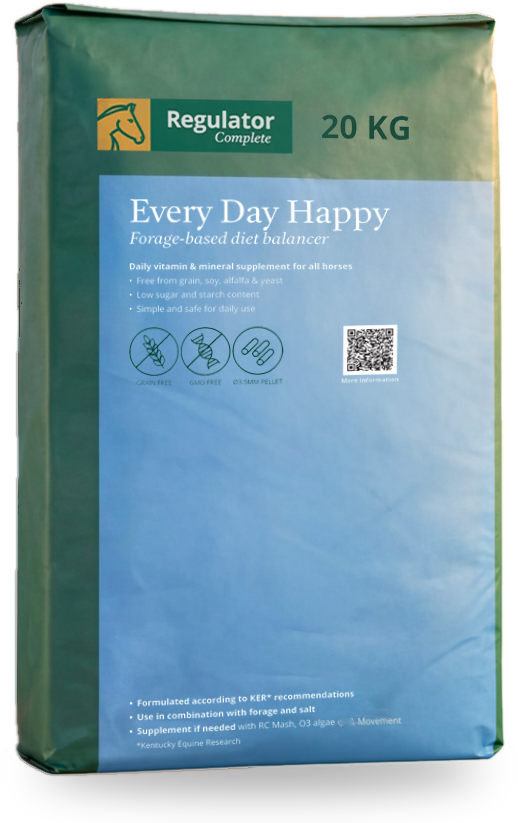
Every Day Happy
A complete vitamin and mineral feed for what forage often lacks. Use your analysis when choosing Normal or Ekstra dosage.
599,00 kr. 20 kg
Calculate amount and daily cost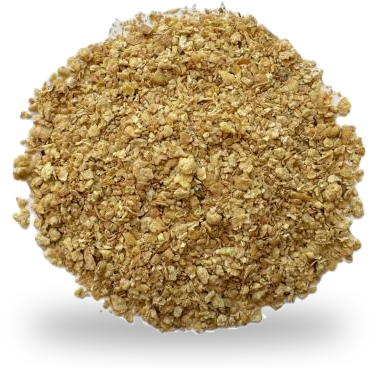
If protein is lacking
Soya bean meal, NON GMO
Toasted soya bean meal with 44 to 48 % crude protein, as a protein source in the manger. The amount depends on the protein percentage of the forage. At 6 % protein in the forage: approximately 125 to 130 g per 100 kg of horse.
189,00 kr. 20 kg

Need help?
Phone consultation
Let's look at your horse's feed and your analysis together.
You don't solve a high sugar content with a supplement, but by adjusting the forage.
250,00 kr. incl. VAT
Book a phone advice callLearn more
How to read the result
How to read your forage analysis
We've collected a number of analyses so you can see which values to enter. Click an analysis to open it.


Sugar: start here if your horse has a cresty neck, is overweight or is sugar-sensitive
Recommendation: 0.5 to 1 g per kg body weight per day. More than 2 g per kg body weight per day is not recommended.
If the sugar is too high
- Switch to a forage with a lower sugar content, or
- reduce the amount and replace some of it with straw or grass seed straw.
- Add an extra protein source to the manger so your horse still gets enough protein.
- Increase the workload if your horse is healthy and able to work.
Important to understand. If the sugar content is too high, adding blood sugar regulating or herbal products won't help. What matters is reducing sugar intake. It's the forage that needs adjusting.
In short: too much sugar has to be solved in the forage. You can always top up protein afterwards.
How much sugar can a good doer tolerate?
Straw for horses when the forage has too much sugar
Crude protein: is your horse getting enough building blocks?
Recommendation: 1.5 g per kg body weight per day. This applies to horses in normal work. Growing horses, lactating mares and horses in hard work have an increased protein requirement.
If protein is too low
- Choose a forage with a higher protein content, or
- supplement with a protein source in the manger.
Protein: building blocks, not just numbers
Protein sources for horses: what's the difference?
NDF: chewing time and bulk
NDF of 40 to 60 % of dry matter is within the normal range.
- 40 %: soft, eaten quickly
- 50 %: balanced, suitable chewing time
- 60 %: coarse, long chewing time
The higher the NDF, the more chewing and bulk. High NDF typically suits mature good doers with healthy teeth and chewing. It is less suitable for foals and growing youngstock, and for horses with high requirements, e.g. stallions, competition horses and broodmares, because the feed takes up a lot of room relative to its energy and protein.
Amount of forage: is your horse getting enough?
Recommendation: at least 1.5 kg dry matter (DM) per 100 kg body weight per day, ideally up to 2 kg.
Specific amounts per 100 kg body weight
- Hay (80 to 85 % DM): 1.8 to 1.9 kg
- Haylage (50 to 70 % DM): 2.1 to 3.0 kg
- Grass (20 to 40 % DM): 3.8 to 7.5 kg
- Straw (80 to 85 % DM): 1.8 to 1.9 kg. Straw provides almost no nutrition, but it does provide fibre and chewing time, and is only used as a supplement.
Example: for a 500 kg horse, multiply the figures by 5. Haylage: 2.1 to 3.0 kg times 5 is 11 to 15 kg per day.
In short: the amount of forage is the foundation. Adjust the amount first, then look at sugar, protein and NDF.
This calculator was developed by and for Regulator Complete ApS. All rights reserved.
