

Horses need salt
Just like humans, horses also need salt. Salt is necessary for our horses to thrive and function in their daily lives.
But why is salt so important, and what does science actually say about horses and their need for salt? We've asked feed company Regulator Complete to enlighten us all on that.
Not getting enough salt can have major consequences for both horses and humans. That's why it's important that we make sure our horses get sufficient amounts of salt.
How much salt does a horse need?
What does published science say about salt?
When we look at the science, INRA (European recommendation for equine nutrition based on Wageningen University in the Netherlands) and NRC 2007 (the US official recommendation for minimum nutritional requirements for horses) both show that 10 grams of salt per 100 kg horse per day only just covers the need.
In addition, a number of different research studies from Sweden over a 25-30 year period indicate that the need is 2 grams of Sodium (Na) and 8 grams of Chloride (Cl) per 100 kg horse. This means that a 500 kg horse needs 10 grams of Na and 40 grams of Cl per day, respectively.
There is agreement on this in Europe, the USA and therefore also Sweden.
Why does the horse need salt?
All mammals need salt to maintain normal cellular functions, including fluid balance and communication between the nervous system and muscles.
There is scientific consensus that horses need at least 10 grams of salt per 100 kg horse for maintenance and more in heat, during work, as well as during pregnancy and lactation.
If we were to create a conversion factor for regular salt, it would look like this:
10 grams of salt contains 3.9 g Na and 6.1 g Cl and to meet the norm for Cl for a horse in maintenance/flock, a 100 kg horse must be given 13-14 grams of salt per day.
When we look at what they recommend at KER (Kentucky Equine Research), there is not a comprehensive overview. However, we see that KER puts the macrominerals 1.3-2.1 times higher than NRC does.
In the past, hay was salted, and there was more salt in feed mixtures, which horses were given much larger amounts of, often 3-4 kg of grain daily. This is almost no longer the case. Salt deficiency is probably a significant contributing factor in many horses' health problems from colic to musculoskeletal injuries, because when muscles become overtired, other tissues such as tendons and ligaments are overloaded.
The horse's salt needs
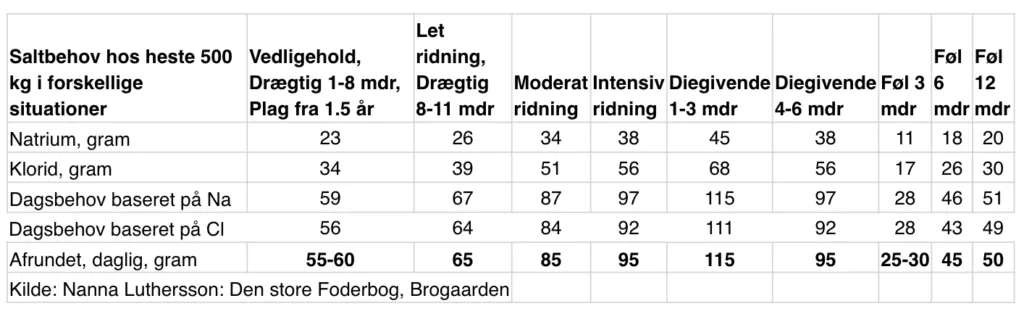
Below you can see how much salt a horse weighing around 500 kg should have, if you take into account its workload.
Salt deficiency?
Long-term lack of salt causes the horse's fluid balance to become unbalanced, it has great difficulty regulating muscle work, energy and inflammation and has difficulty dealing with sore hooves, muscles, joints and tendons. In addition, lack of salt can be the direct cause of colic, because the horse drinks too little, which negatively affects all muscle function, including the peristalsis of the intestine (the smooth muscles). The horse needs salt in sufficient quantities to, among other things, have good working energy and endurance, work correctly through the body and build muscle, which means creating or maintaining a good topline.
What factors can influence a horse's need for salt in one direction or another?
The need for salt increases during work, when the horse sweats, in heat and during pregnancy and especially lactation, where the need for salt is almost doubled compared to maintenance and early pregnancy.
Why does the horse consume too much salt?
How do you find out if your horse has consumed too much salt?
When some horses apparently overeat salt, they are probably in deficit, unbalancedly nourished and thus exhausted/unbalanced in their adrenal function (this also applies to other species).
In studies where salt has been removed for a period of time to investigate the physiological consequences, up to a few hundred grams of salt daily have subsequently been given to a 500-600 kg horse once the measurements were complete to quickly correct the deficit.
What are the consequences of your horse consuming too much salt?
The horse – like humans – becomes thirstier from eating a lot of salt, and the fluid must eventually pass through the kidneys as urine. This means that the horse drinks more and urinates more, which can cost extra bedding. It is not dangerous for the horse to consume extra fluid if it has normal kidney, heart and circulatory function, but it may be a good idea to let the horse drink from a bucket/tub, so that you get a real feel for the fluid intake.
What should you as a horse owner do if you think your horse is consuming too much salt?
If you suspect that your horse is eating rock salt, it is a good idea to give the horse the correct amount of loose salt for its size and workload directly in the feed. You can weigh the rock salt once a month to determine the amount consumed, and there is usually no problem when you do the math.
How can you ensure that your horse maintains an adequate salt intake year-round?
It is very easy to check what the horse actually needs in terms of salt. Either by looking at the horse's needs in a feeding program such as SundHest.dk or looking up 'The Big Feed Book', which is written by veterinarian Nannas Luthersson. Here you can see that a 500 kg horse in maintenance/fold needs 23 grams of Sodium and 34 grams of Chloride daily, corresponding to a total of 55-60 grams of salt per 500 kg or 11-12 grams/100 kg. Then you find a suitable measuring spoon and give your horse the salt it needs in the feed.
On summer grass, you can give loose salt in a manger under a half-roof and write down how much you pour in, for example every two weeks or monthly, and thus calculate how much is lost in relation to the number of horses in the herd.
Salt is essential in a horse's diet, so it's important that you as a horse owner know how much salt your horse is getting. Try to calculate it yourself or contact a feed expert if you're in doubt. Most places offer a free analysis.
The article is published in Despite Everything
