


Horses and Omega 3
The horse's body - like that of other mammals - consists of proteins, fats and carbohydrates in a multitude of cells, tissues and organs. Here fats and especially the essential fatty acids Omega 3 and Omega 6 play a central role in function and health.
Conclusion first
-
Your horse must have a fully comprehensive vitamin and mineral supplement (e.g. Every Day Happy ) to be able to convert Omega 3 correctly.
-
If the horse has a serious imbalance between Omega 3 and Omega 6 , it must be supplied with Omega 3 in a form that is absorbed directly into the cells.
-
Here, RC O3 Algae is an obvious solution because it contains EPA and DHA in an easily absorbable form.
What are fatty acids?
Fats are found both in energy metabolism and in cell membranes and are divided into:
-
Saturated fatty acids
-
Monounsaturated fatty acids
-
Polyunsaturated fatty acids (including Omega 3 and Omega 6)
All feed materials contain a mixture of these. The distribution in horses is remarkably stable:
-
30–40% saturated
-
40–50% monounsaturated
-
15–25% polyunsaturated
The essential fatty acids – Omega 3 and 6
Horses cannot produce Omega 3 and 6 themselves, they must be supplied through the feed. They are part of all cells and are necessary for:
-
Immune defense
-
Circuit
-
Inflammation control
-
Energy and hormone balance
-
Fertility, metabolism and tissue function
Omega 6 triggers an inflammatory process (e.g. in the event of injury or infection).
Omega 3 ends inflammation and helps the body return to balance.
When the balance shifts
A healthy horse has a balance of approximately 1:4 (Omega 3:Omega 6).
But food, disease and environment can create an imbalance where inflammation is not terminated correctly.
Symptoms may include:
-
Skin problems: dandruff, itching, poor shedding
-
Joint problems, pain, injuries that heal slowly
-
Loss of energy, low stress threshold, irritability
-
Infections and poor wound healing
-
Digestive disorders, loose stools or sluggish stomach
-
Fluid imbalance: excessive sweating, thirst, low urine output
-
Reduced fertility and sperm quality
Sources in the feed
-
Omega 6 (linoleic acid) : oats, rapeseed, corn, sunflower, grape seeds, hemp, chia, flaxseed
-
Omega 3 (alpha-linolenic acid, ALA) : fresh grass, flaxseed, hemp, chia, rapeseed
The problem: ALA (plant-based Omega 3) must be converted into EPA and DHA.
Healthy horses can convert a lot, but sick, stressed, overweight or vitamin/mineral deficient horses convert very little.
Why marine sources are more efficient
EPA and DHA are found directly in algae and fish – and are immediately absorbed into the horse's cells.
-
Marine oils increase EPA and DHA in the blood 3–7 times and in the muscles up to 2 times more than plant oils.
-
Algae oil is more effective than fish oil because it comes directly from the algae and does not contain environmental toxins.
RC O3 Algae is therefore one of the most potent sources of easily absorbable EPA and DHA.
Important interaction with vitamins and minerals
In order for the horse to utilize Omega 3 optimally, the following is required:
-
Vitamin E (antioxidant)
-
Vitamin B group
-
Selenium, zinc and magnesium
Lack of coverage here can inhibit the conversion of ALA to EPA/DHA.
Conclusion
-
Omega 3 and Omega 6 are essential fatty acids, but balance is crucial.
-
A sufficient vitamin and mineral supplement is a prerequisite for being able to utilize Omega 3.
-
If the horse has an imbalance, marine sources such as algae oil are the most effective solution.
👉 That's why RC O3 Algae - also used in Peak Performance - is recommended when the horse needs easily absorbable Omega 3 fatty acids (EPA and DHA).
Relative importance of EPA and DHA in various health aspects*
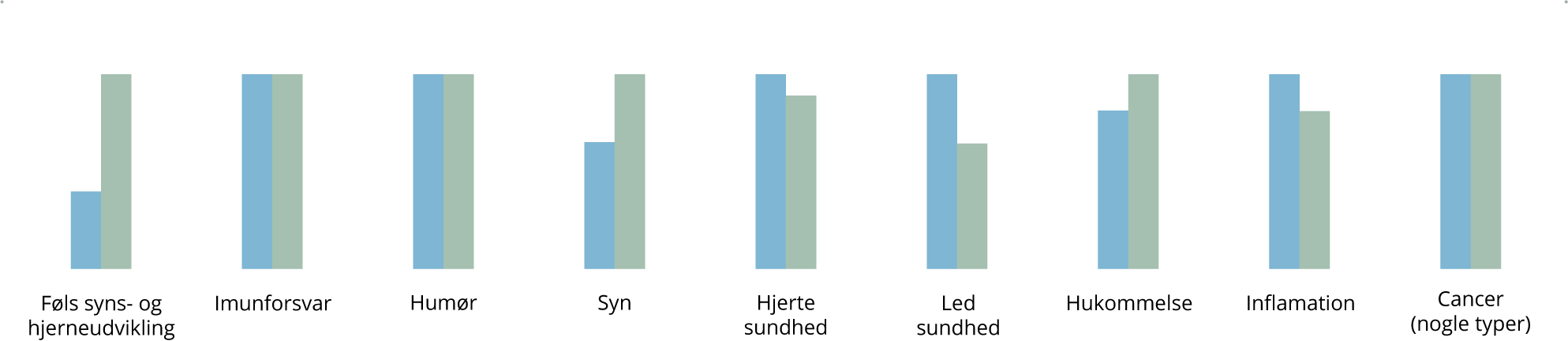
* EPA = Blue - DHA = Green
*Includes ongoing research. Disclaimer: Not intended to make claims about efficacy or the ratio of EPA:DHA.
Source: Veramaris VOF Netherlands .


Comments (0)
There are no comments for this article. Be the first one to leave a message!